Mathematics Encyclopedia: Discovering the Beauty of Infinity
✨ Mandelbrot Set — 'God's Fingerprint': The most famous icon of fractal geometry. Generated by a simple iterative formula, it possesses infinite complexity; no matter how much you zoom in, you discover miniature structures along the edges that mirror the whole.
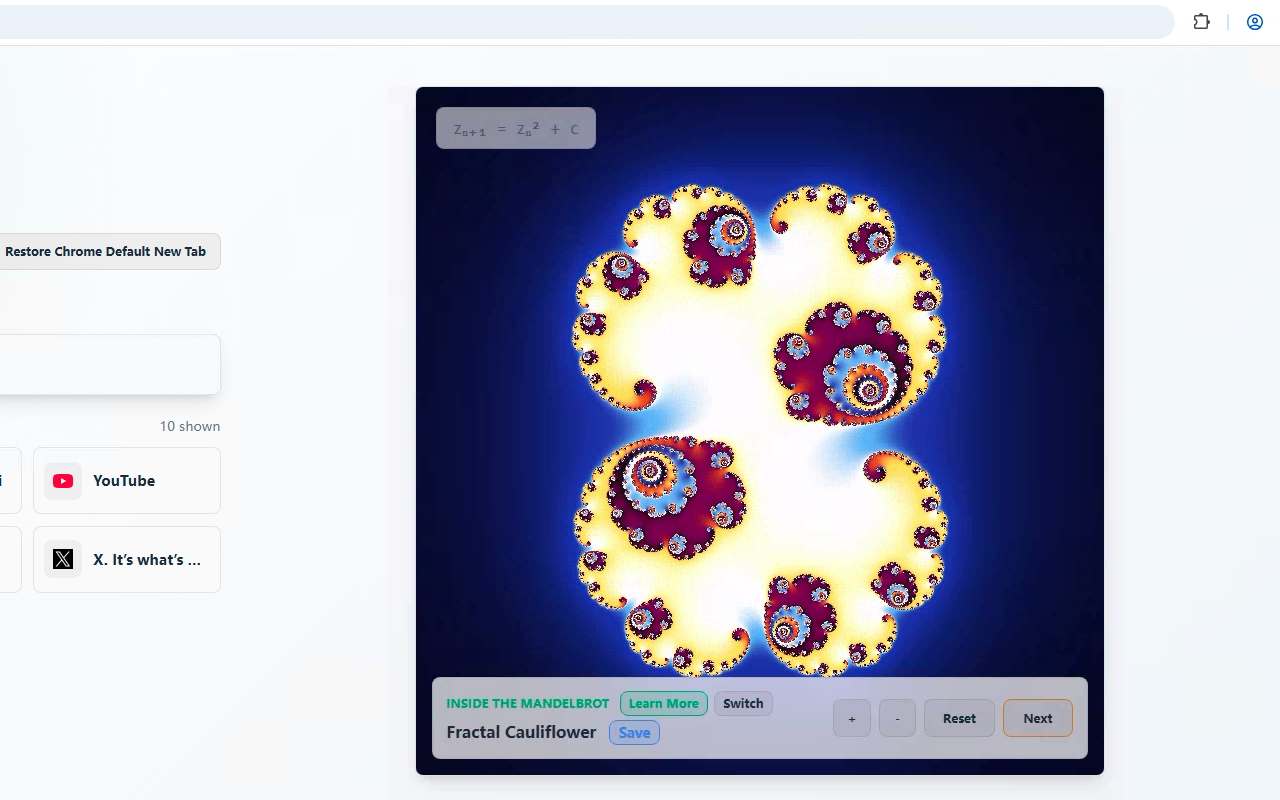
✨ Julia Set — The Mandelbrot Set's Twin: If the Mandelbrot Set is a map of all fractals, then the Julia Set represents the unique landscape corresponding to each point on that map, showcasing the boundless allure of complex plane mappings.
✨ Golden Spiral — The Universe's Proportion: An equiangular spiral constructed based on the Golden Ratio (φ ≈ 1.618). From the spiral arms of distant galaxies to the shell of a tiny nautilus, it stands as the most visually harmonious and balanced geometric form.
✨ Fibonacci Phyllotaxis — Nature's Efficiency: The 'Golden Angle' (approximately 137.5°) governing the arrangement of sunflower seeds ensures optimal space utilization—a testament to the mathematical wisdom inherent in plant evolution.
✨ Barnsley Fern — The coding of life: a masterpiece of Iterated Function Systems (IFS). Using just four simple linear transformations, it perfectly simulates the complex forms of ferns found in nature.
✨ Fibonacci Tree — Recursive growth: branching patterns governed by the Fibonacci sequence, simulating the self-similar structures found in trees, blood vessels, and even river basins.
✨ Lorenz Attractor — The butterfly effect: an icon of chaos theory. This butterfly-shaped attractor demonstrates how even fully deterministic equations can give rise to complex, unpredictable behavior.
✨ Hopalong Attractor — The fabric of chaos: created through simple piecewise coordinate manipulation, generating psychedelic patterns with a profound sense of depth and intricate, woven textures.
✨ Clifford Attractor — A dance within chaos: a strange attractor highly sensitive to parameters, where minute adjustments can transform the pattern from a simple ring into complex, wing-like structures.
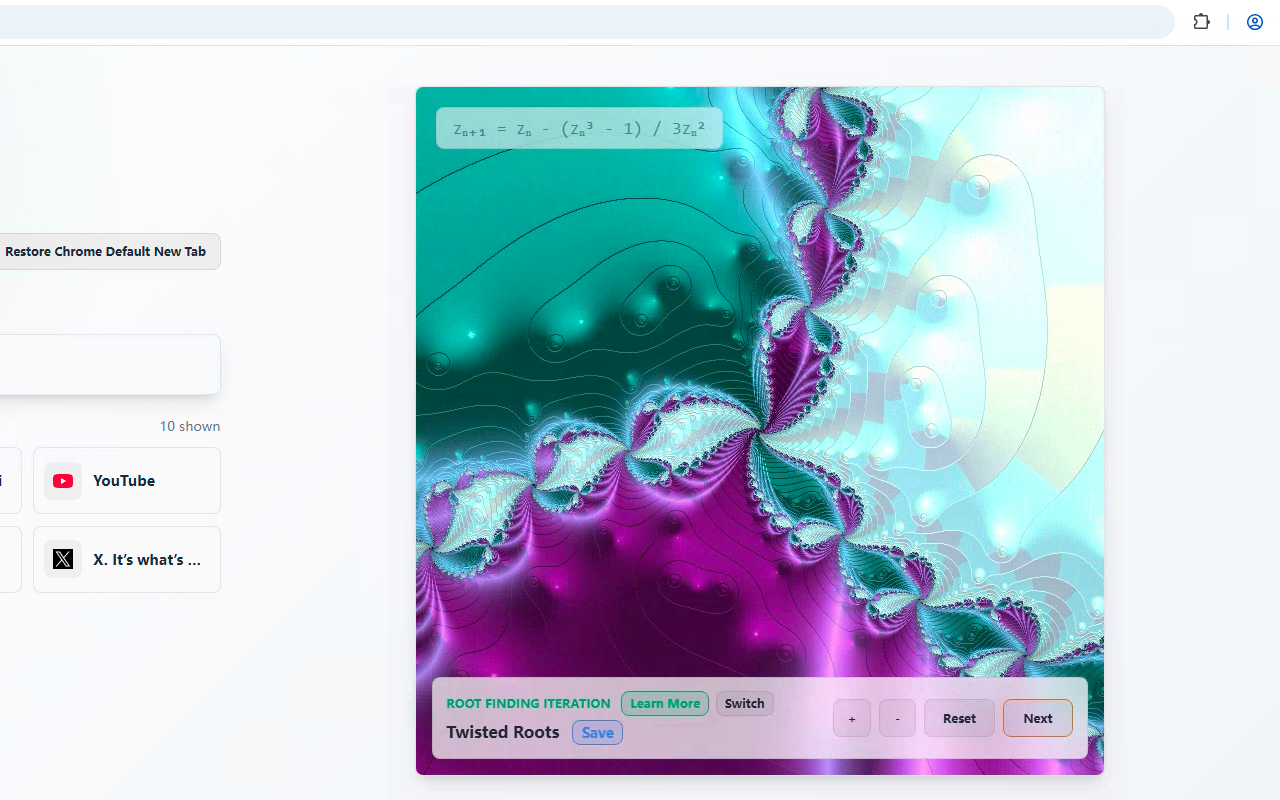
✨ Newton Fractal — The trajectory of seeking truth: It maps the iterative paths taken to find the roots of a polynomial equation in the complex plane, revealing stunning symmetry and dazzling boundaries.
✨ Langton's Ant — The power of emergence: Simple rules give rise to complex behavior. After a period of chaotic wandering, this 'ant' constructs an ordered 'highway,' serving as a classic example in the study of emergent phenomena and cellular automata.
✨ Aizawa Attractor — A galaxy within chaos: It illustrates the fascinating process of a trajectory spiraling within a toroidal region in a 3D dynamical system, creating a dense, interwoven structure that resembles a spinning top.
✨ Lissajous Curves — Harmonic resonance: A trajectory formed by the superposition of oscillations in two perpendicular directions. When frequencies share an integer ratio, they produce closed curves of exquisite symmetry—a common sight in physics signal analysis.
✨ Apollonian Gasket — Descartes' Kiss: Starting with three mutually tangent circles, new circles are recursively inscribed into the gaps, each tangent to the three surrounding circles. It perfectly exemplifies Descartes' Circle Theorem, creating an infinitely nested, jewel-like geometric pattern of circles.
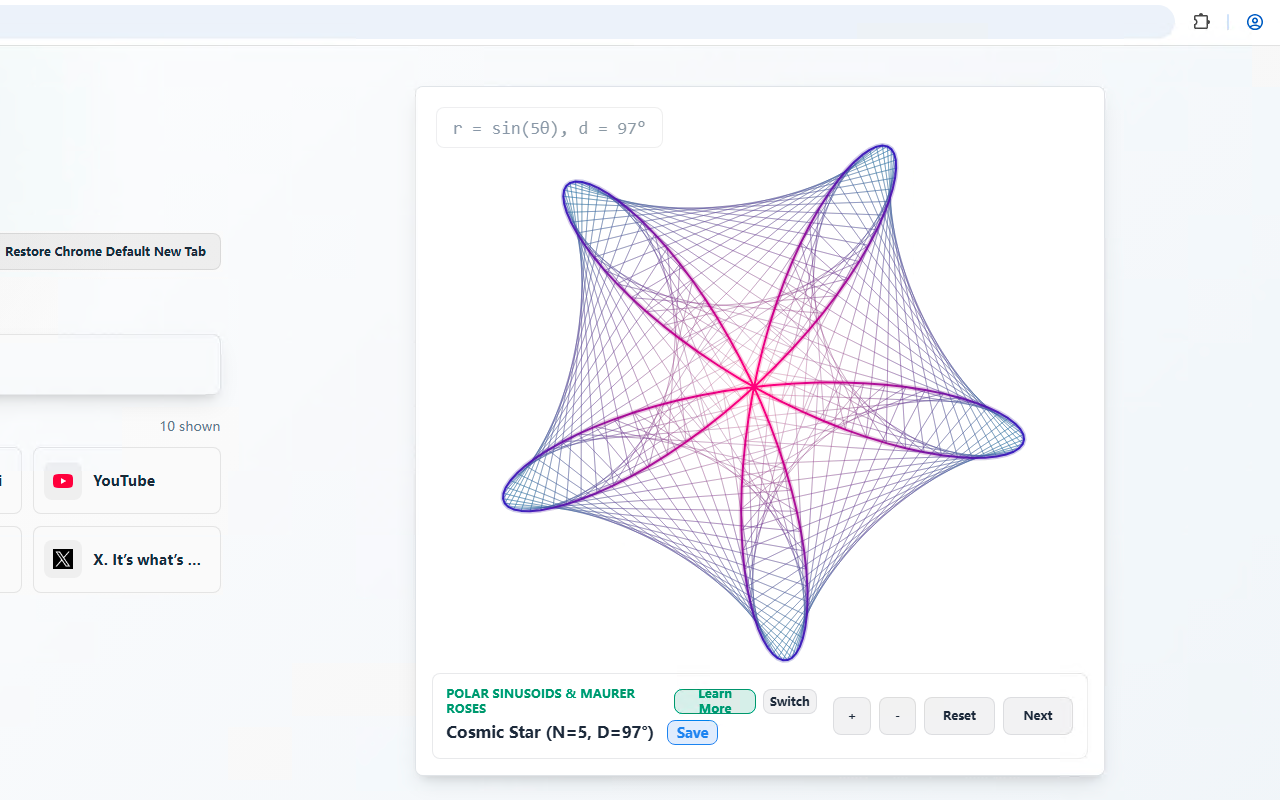
✨ Rose Curves & Maurer Roses — A Melody in Polar Coordinates: Rose curves are aesthetically striking sinusoidal curves defined in polar coordinates, where specific parameters determine the number of interlacing petals. Maurer roses, meanwhile, connect sampled points based on angular steps, creating intricate star-like grids and interference patterns.
✨ Epicycloid — A Dance of Geometric Orbits: This traces the path of a point on a moving circle as it rolls along the exterior of a fixed circle. It encompasses classic cycloids like the cardioid and nephroid, showcasing a process of pure geometric evolution.
✨ Spirograph — Nostalgic Emblems: Simulating the motion of the classic Spirograph toy, this effect superimposes multiple circular movements to generate symmetrical, captivating geometric emblems and interference patterns.
✨ Noise Flow Field — A Surge of Order: Utilizing a smooth vector field generated by Ken Perlin’s gradient noise, this guides the movement of thousands of tiny particles. They converge on the canvas to create generative art scenes reminiscent of organic silk, auroras, or deep-sea eddies.
✨ Bifurcation Diagram — The Path to Chaos: This illustrates how a dynamical system transitions from stability to chaos through successive 'bifurcations' (splits). The famous Feigenbaum cascade reveals the profound complexity hidden behind simple equations.
✨ Chladni Figures — Visualizing sound: geometric patterns formed by sand grains on a vibrating thin plate. Revealing the nodal lines created by acoustic resonance, they represent one of the most artistic expressions in physical acoustics.
✨ Double Pendulum — A chaotic dance: two interconnected pendulums forming a chaotic system extremely sensitive to initial conditions. Its intricate, non-repeating trajectories offer a vivid illustration of the 'butterfly effect'.
✨ Dragon Curve — Recursive paper folding: a space-filling curve generated through simple, repeated folding rules. It never intersects itself and perfectly tiles the plane, showcasing the geometric beauty born of pure logic.
✨ Hilbert Curve — Order in space-filling: a one-dimensional line that, through continuous recursive rotation, seamlessly fills an entire two-dimensional square. It is a classic example of locality-preserving mapping in computer science.
✨ Penrose Tiling — 'Impossible' symmetry: a non-periodic tiling pattern discovered by Roger Penrose. It features striking five-fold rotational symmetry and a pattern that never exactly repeats, foreshadowing the existence of quasicrystalline matter.
✨ Sierpinski Carpet — Recursive voids: A fractal formed by repeatedly removing the central square from a larger square. In the limit, its area becomes zero while its perimeter approaches infinity.
✨ Sierpinski Triangle — Infinite depth: A classic example of a self-similar fractal. Whether generated through recursive hole-punching or the random 'Chaos Game,' its precise triangular structure remains consistent at any scale.
✨ Voronoi Diagram — Spatial partitioning: A division of a plane into distinct regions based on proximity to seed points. This rule of naturally maximizing efficiency in partitioning is found everywhere in the natural world.
✨ Koch Snowflake — Continuous yet non-differentiable: A magnificent snowflake generated recursively from a simple equilateral triangle. It reveals the mathematical property of having an infinite perimeter yet finite area—a perfect blend of mathematical aesthetics and logical order.
✨ Pythagoras Tree — A forest of the Pythagorean theorem: Each branching point forms a right-angled triangle, vividly illustrating the Pythagorean theorem. As iterations progress, orderly squares grow into a fractal tree teeming with vitality.
✨ Reaction-Diffusion System — Nature's patterns: A simulation of the formation of zebra stripes, leopard spots, and coral structures. Through the real-time reaction and diffusion of two virtual chemical substances, organic textures reminiscent of the rhythms of life emerge on the canvas.
✨ Lévy C Curve — Self-similar folds: Generated by repeatedly folding a line segment at right angles, the overall form and local details exhibit perfect self-similarity—a testament to the simple, elegant beauty of recursion in fractal geometry.
✨ Gumowski-Mira Attractor — The beauty of order within chaos. Originating from research into particle accelerator orbit stability, this equation uses simple quadratic iterations to sketch intricate patterns resembling nautilus shells, flower petals, and butterfly wings, revealing the hidden symmetry and harmony within chaotic systems.
✨ De Jong Attractor — Four parameters, infinite forms. Discovered by astronomer Peter de Jong, this attractor generates dense, nebula-like point-cloud patterns with distinct layering using just a combination of four sine and cosine parameters; it stands as one of the most iconic visual symbols in the realm of chaotic art.
✨ Ikeda Attractor — Light dancing in chaos. Stemming from research into nonlinear optical resonators, this equation simulates the phase drift that occurs as laser light repeatedly reflects within a cavity, tracing swirling, storm-like patterns that rotate in layers and unveil the mysteries of deterministic chaos in optical systems.