Fibonacci Phyllotaxis
Why do sunflowers, pine cones, and pineapples all feature similar spiral patterns?
If you observe a sunflower closely, you will notice that its seeds are not arranged haphazardly.
They form graceful spirals winding in both clockwise and counter-clockwise directions. Pine cones, pineapples, succulents, and even some cacti exhibit similar arrangements.
This is no coincidence. These natural patterns are all linked to a classic mathematical structure—Fibonacci phyllotaxis.
People seeing it for the first time are usually struck by one thing: a simple rule can generate such natural, harmonious patterns.
What is Fibonacci phyllotaxis?
Phyllotaxis refers to the arrangement of leaves, petals, or seeds on a plant.
As many plants grow, new leaves do not emerge directly above the previous ones; instead, they rotate continuously at a fixed angle.
Through this ongoing growth, the leaves form the familiar spiral patterns we recognize.
Remarkably, this arrangement is not only aesthetically pleasing but also helps the plant make more efficient use of sunlight, rainwater, and growing space.
Why does it look so natural?
The secret behind Fibonacci phyllotaxis lies in a specific angle: approximately 137.5°. This angle is commonly known as the Golden Angle.
With the generation of each new point, the position rotates by approximately 137.5° relative to the previous one, gradually expanding outward. Repeatedly performing this simple process creates a uniform and elegant spiral arrangement.
This arrangement minimizes excessive overlap between points, allowing for more efficient use of space. It is for this reason that many plants in nature have 'chosen' this type of growth pattern.
Comparison: Sunflower vs. Generated Image
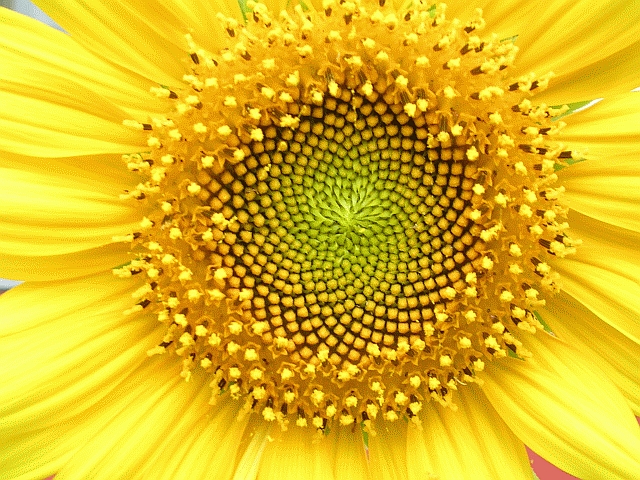
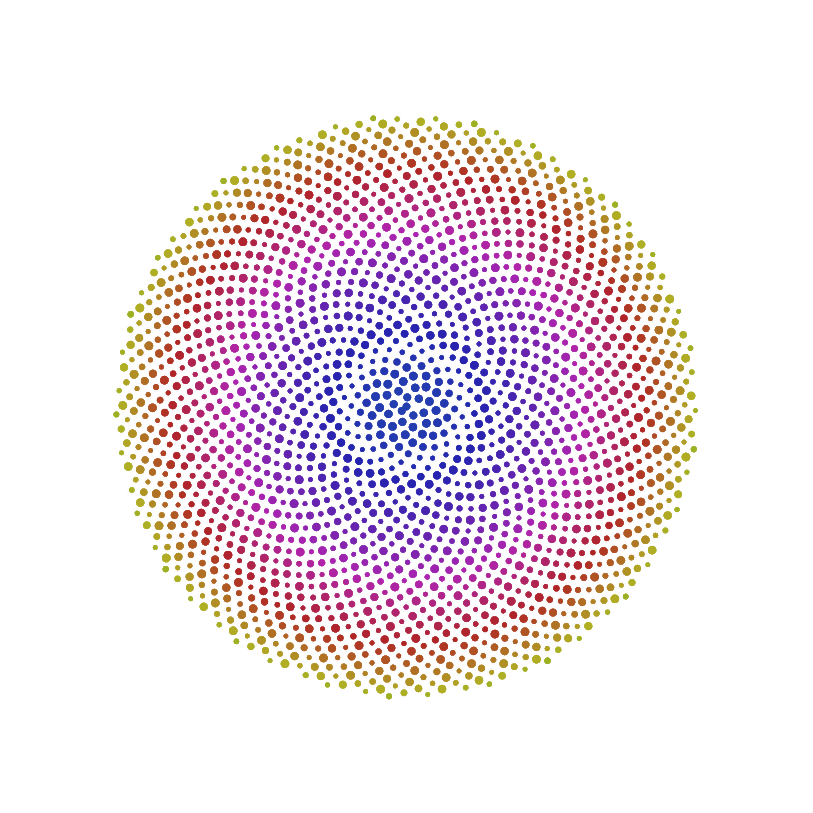
Real sunflower
Fibonacci phyllotaxis
The arrangement of seeds in nature bears a striking resemblance to mathematically generated patterns.
Where is the Fibonacci sequence?
When many people first hear this name, they think of the famous Fibonacci sequence: 1, 1, 2, 3, 5, 8, 13, 21...
What is its connection to phyllotaxis (leaf arrangement)?
If you observe the spirals on a plant closely, you will find that the number of clockwise spirals and the number of counter-clockwise spirals are often Fibonacci numbers.
For example: 34 and 55, 55 and 89, or 89 and 144. Different plants exhibit different numbers, but these numbers almost always come from the Fibonacci sequence.
This is also the origin of the term 'Fibonacci phyllotaxis'.
Try out different arrangement effects
Although the golden angle most closely resembles the arrangement patterns found in nature, even slight changes to the angle result in noticeable shifts in the pattern.
You can click the 'Next' button below the image to explore a few presets and see how the arrangement differs with various parameters.
Why are mathematics and nature so similar?
The most fascinating aspect of Fibonacci phyllotaxis is not merely the beautiful spirals it creates; rather, it reveals that:
Many complex forms in the natural world actually arise from simple, efficient growth rules.
Plants do not 'calculate' the Fibonacci sequence; they simply sprout new leaves and seeds in the manner most conducive to growth. Yet, the resulting arrangement aligns astonishingly well with mathematical patterns—a truly wondrous intersection of mathematics and nature.
A Classic Pattern Spanning Science and Art
Today, Fibonacci phyllotaxis is not only used to study plant growth but also appears widely in art and design, architecture, data visualization, and computer graphics.
Whether it is a sunflower, a pinecone, or a series of dots on a screen, they all reveal the same beauty of order: a simple angle, repeated over and over, ultimately creating a harmonious and elegant pattern.
Continue Exploring the World of Fractals
Fibonacci phyllotaxis reveals hidden mathematical patterns in nature, yet this is just one part of the journey of discovery.
If you enjoy the process of creating complex structures from simple rules, why not experience the Barnsley Fern to see how mathematics can 'grow' a plant? Or explore the Julia Set and Mandelbrot Set to discover the allure of infinite variation and the fractal world.
Some mathematics depicts nature, some creates fractals, and some bridges art and science. Together, they reveal a profound truth: nature and mathematics are far more closely connected than we imagine.
You can also explore more fascinating mathematical shapes or read more about Fibonacci phyllotaxis on Wikipedia.