Exploring Newton Fractals
A story spanning over three centuries: Newton himself never saw this image, as it requires a computer to generate.
Explore Newton fractals and witness how mathematical ideas from over three hundred years ago blossom into a brilliant and complex fractal world today.
Newton never saw this image, yet it came into existence because of him
Many people know Newton—yes, the Newton associated with the apple falling on his head.
The story of the falling apple (though its historical accuracy is debatable), universal gravitation, the three laws of motion... these are all staples of textbooks.
But in fact, he was also a brilliant mathematician. Few people realize that Newton left behind something special: a mathematical method capable of generating stunning fractal patterns.
Interestingly, Newton himself never saw these patterns, because computers did not yet exist when he devised the method.
It was not until more than three centuries later that people discovered: if a computer repeats Newton's method millions of times and renders the results in various colors, the outcome is a breathtaking work of art.
This is the Newton fractal.
Perhaps this is the most wondrous aspect of mathematics: a method invented for calculation transforms, centuries later, into a work of art.
Imagine a peculiar navigation map
For now, put aside formulas and don't worry about 'equations'; let's start with a simple thought experiment.
Imagine we have a map where any location can serve as a starting point.
Suppose there are three destinations on the map:
🔴 Red City
🟢 Green City
🔵 Blue City
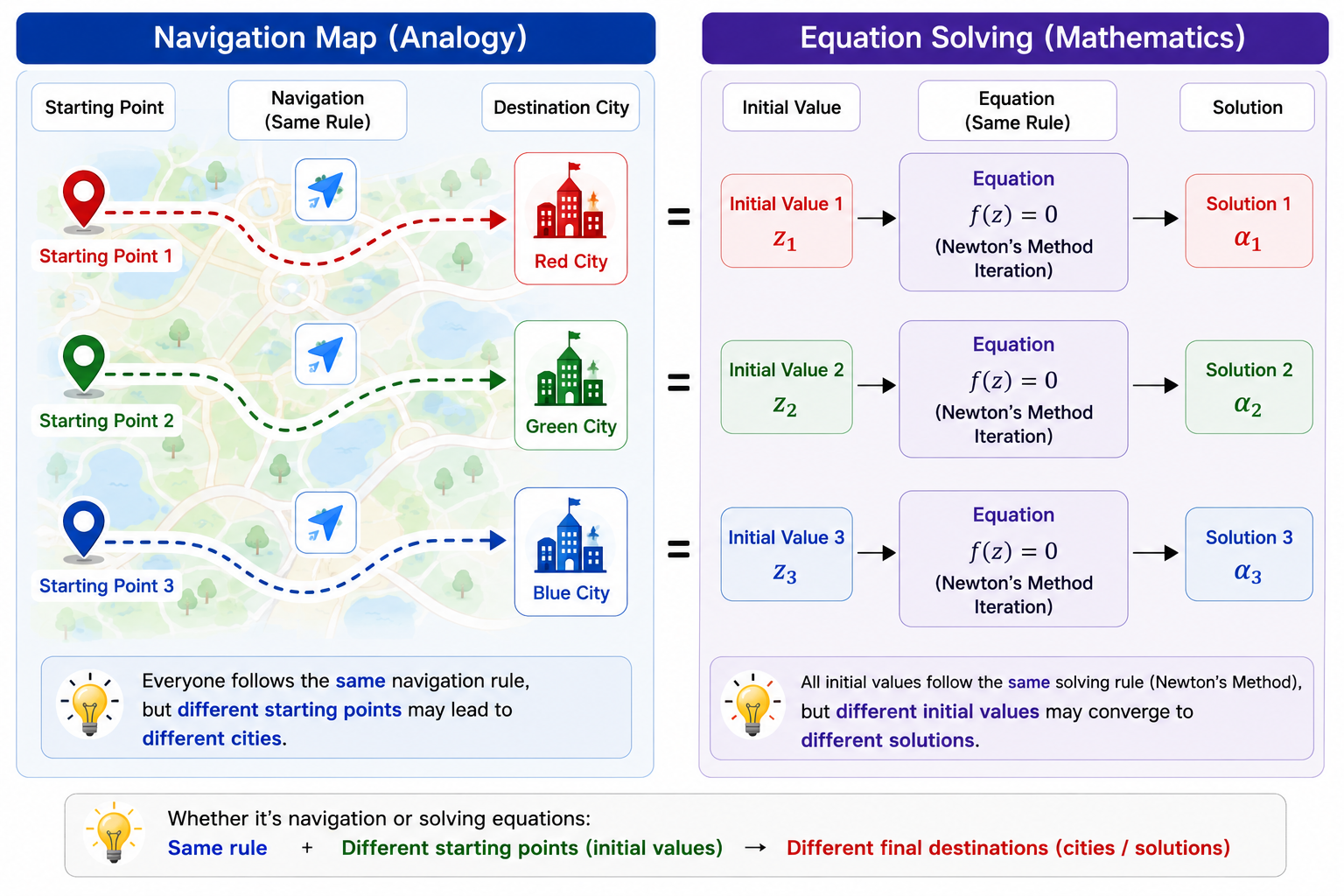
Everyone must follow the same set of navigation rules: with every step taken, the navigation system recalculates the route based on your current location to determine the next move, guiding you progressively closer to one of the destinations. No one is free to choose their own path; everyone travels strictly according to the route planned by the navigation system.
Coloring the Starting Points
Next, let's do something interesting.
We will start from every location on the map and see where each one ends up. If a path leads to a red city, we color the starting point red. If it leads to a green city, we color the starting point green. If it leads to a blue city, we color the starting point blue.
Note that we are not coloring the destination, but rather every starting point. Eventually, the entire map will be filled with different colors.
This is the most intuitive way to understand the Newton fractal.
Each color represents a different endpoint
Different Newton fractals may feature varying numbers of colors—some have only three, others four, and some even more—because each color represents a distinct final outcome.
Consequently, different mathematical problems give rise to completely different patterns.
Although the patterns vary, they all stem from the same underlying concept: starting from different points and ultimately arriving at different destinations.
Why are the boundaries so complex?
This is where the true magic lies: two starting points on the map that are almost touching—separated by perhaps just a single small step—can lead to completely different destinations.
You might think: two people starting almost side-by-side on the map, separated by just one step—surely, being so close, they would both end up in the Red City.
The result? They don't. One goes to the Red City, while the other goes to the Green City.
Consequently, an increasingly complex boundary forms at the interface between the red and blue zones.
If you zoom in further on these boundaries, you discover new textures, new swirls, and new details. No matter how much you magnify the view, this complex structure keeps reappearing. And so, a fractal is formed.
Try out different maps
Different rules yield vastly different maps: some resemble flowers, others look like snowflakes; some exhibit perfect rotational symmetry, while others feature intricate, delicate boundaries.
Although the patterns vary endlessly, the underlying concept remains the same: each color represents a path that ultimately leads to the same 'destination'.
That analogy wasn't entirely accurate
To make it easier to understand, we previously compared the Newton fractal to a navigation map.
In the actual mathematical process, however, there are no cities or roads.
What the computer does is this: starting from different initial values, it repeatedly performs calculations based on the same set of rules—specifically, the same equation. With each step, the next move is adjusted based on the current result. Eventually, the value gets closer and closer to a specific answer. Mathematicians call this method Newton's method. The "destinations" ultimately reached are the solutions to the equation.
So, the cities in the story represent the different mathematical answers; the navigation represents Newton's method; and the entire colorful map records which answer each starting value eventually leads to.
Although the actual mathematics is more complex than this story, they convey the same underlying concept.
What are 'equations' and 'solving equations'?
Let's look at the simplest example. Suppose I ask: x2 = 9—what does x equal?
The answer is 3, and also -3; both are valid answers. In mathematics, x2 = 9 is called an equation, and finding the answer is called solving the equation—it's really not mysterious at all.
So, what exactly is 'Newton's Method'?
Newton faced a problem: suppose there is a very complex equation. Mathematicians know it definitely has a solution, but what exactly is that solution?
In the days before computers and calculators, many equations were simply impossible to solve.
So, Newton invented a very clever method. The idea is simple: start by making a rough guess at the answer, then use that guess to calculate which direction to adjust in.
Take the equation x2 = 9, for example—suppose you don't know the answer.
You guess 10: too high.
So you try 6: still too high.
Then you guess 4: getting closer.
Then: 3.2
Then: 3.01
Finally: 3.000001—you've found it.
This process is about getting closer and closer to the answer. In mathematics, this is called convergence. Essentially, it means your guesses become increasingly accurate.
Today, this method is known as Newton's Method.
Newton Didn't Set Out to Draw Fractals
When Newton invented this method, he had only one goal: to find the solutions to equations more quickly. There were no computers back then; his sole intention was to accelerate the process of calculating answers.
Later, people used computers to run the calculation for countless starting values and visualized the results using color. Surprisingly, an algorithm originally designed to solve mathematical problems gave rise to such rich and beautiful patterns.
Therefore, Newton fractals were not actually discovered by Newton himself; rather, they are a work of art that 'accidentally' emerged from his method in the computer age. It is more like a 'gift' spanning three centuries: Newton left behind an algorithm, and computers allowed us to see its hidden beauty for the first time.
A Map Mapping 'Answer Destinations'
If we view a Newton fractal as a map, it does not record the locations of cities; instead, it charts the path from a starting point to the specific answer ultimately reached.
Each color represents a distinct final destination. Every complex boundary signifies that even a minute change could lead to a completely different outcome.
For this reason, the Newton fractal is more than just a beautiful pattern—it is a map that charts mathematical principles.
From Newton to the Present Day
Over three centuries ago, Newton devised a method for finding answers. Today, we use computers to transform that method into a fractal world—one that can be endlessly admired and infinitely magnified.
Newton never saw these patterns. Yet today, not only can you view them, but you can also zoom in, explore, and witness firsthand how they take shape step by step. A simple idea can transcend time, blossoming into unexpected beauty in the future.
No one designed these intricate patterns or drew these swirling vortices; all the complex boundaries emerge from the constant repetition of a single set of rules. A technique originally intended to solve mathematical problems has ultimately created a breathtaking work of art.
The most captivating aspect of the Newton fractal is not its utility in helping mathematicians calculate answers, but the revelation that the process of calculation itself can create art.
Continue Exploring the World of Fractals
Newton fractals demonstrate how algorithms can transform the process of seeking an answer into a stunning pattern—just one of the many marvelous expressions found in the mathematical world.
If you enjoy the surprises born of infinite variation, try exploring the Julia set; to discover the most iconic pattern in the fractal realm, look into the Mandelbrot set; meanwhile, the Barnsley fern and Pythagoras tree showcase how simple mathematical rules can create beauty that blends nature and geometry.
Some fractals depict nature, others illustrate recursion, and some capture the journey of finding a solution; together, they reveal that mathematics can not only explain the world but also create breathtaking beauty.
You can also explore more fascinating mathematical patterns or read more about Newton fractals on Wikipedia.