Explore the Sierpinski Triangle
The Sierpinski Triangle: How Does a Single Triangle Transform into an Infinite World of Triangles?
Imagine you are given an ordinary solid triangle (▲). If you were asked what you would end up with after repeatedly cutting out triangles from within it, you might think: 'Wouldn't it just result in a triangle that keeps getting smaller?'
But that is not the case at all. If you repeatedly apply a very simple rule—divide the triangle into four identical smaller triangles and remove the one in the center—you do not end up with an ordinary triangle. Instead, you create a wondrous geometric pattern filled with holes, featuring nested layers and infinite complexity: the Sierpinski triangle.
It All Starts with a Triangle
The first step is very simple: we start with just a single solid triangle—the starting point for the entire pattern. In the language of fractal construction, this is the initial seed shape. At this stage, there are no holes, no complex structures, and no fractal patterns—just an ordinary triangle.
Round 1: Divide it into four triangles
Next, we find the midpoints of the large triangle's three sides and connect them. This divides the original large triangle into four identical smaller triangles, roughly as shown in the image below. Crucially, an inverted small triangle appears in the center.

Round 2: Keep carving it out
Now, the question arises: does the process stop there? No. We still have three small triangles, so we repeat the previous operation on each of them. Each triangle is divided into four, and the central one is removed; thus, one triangle becomes three, then nine, then twenty-seven, and so on...
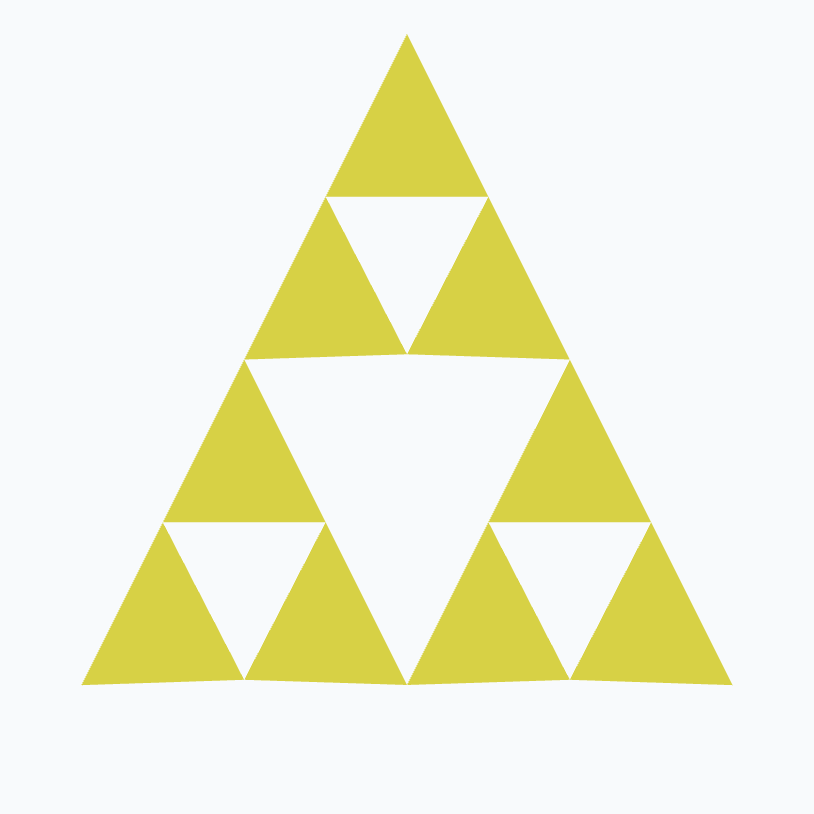
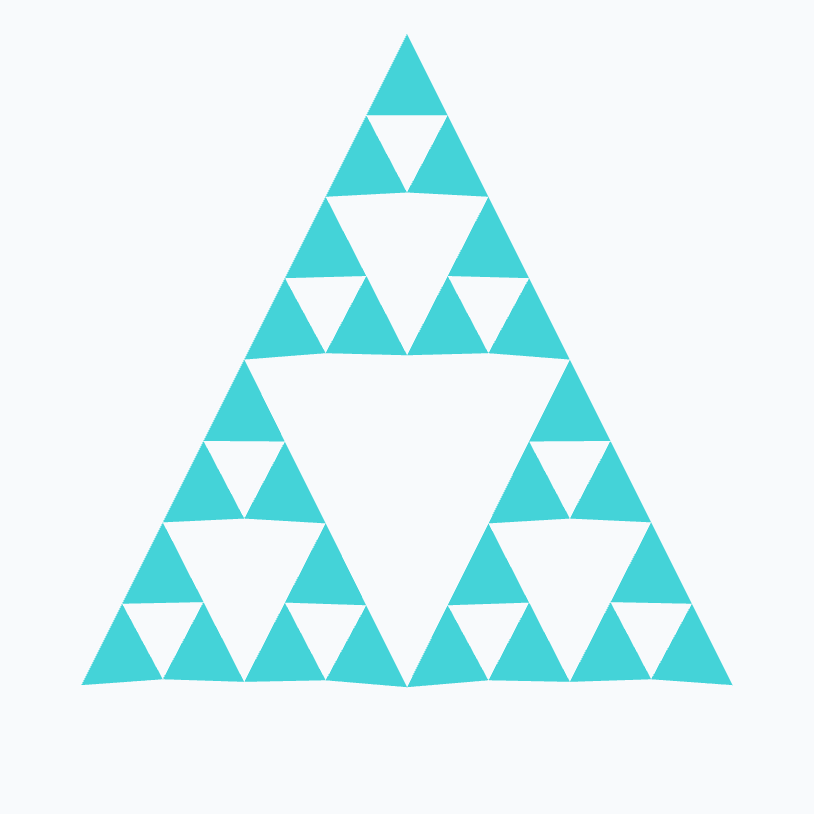
This is recursion, and the concept is very simple: take the action you just performed and apply it again to the new objects. The first time, you operate on the large triangle. The second time, you operate on the three remaining smaller triangles. The third time, you operate on the nine remaining even smaller triangles. The rule never changes from start to finish: simply divide into four parts, then remove the one in the middle.
How did a simple rule lead to such complexity?
Look at the number of triangles: 1 → 3 → 9 → 27 → 81 → 243 → ... With each iteration, the number of triangles triples, while the side length of each triangle is halved. Consequently, the pattern accumulates more and more structures, yet each individual structure becomes increasingly small. Ultimately, you see a large triangle containing smaller triangles, which in turn contain even smaller ones, and so on. Zoom in, and triangles continue to appear. That is the most fascinating part.
If you view the pattern as a whole, you see a single, massive triangle. But if you zoom in on one of its corners, you discover a similar triangular structure. Zoom in further, and there is another. Zoom in again, and yet another appears. Theoretically, this process can continue indefinitely. It is, therefore, a classic example of a self-similar structure.
What is 'self-similarity'?
It sounds complex, but it can be simply understood as: the whole looks very much like its parts.
The Sierpinski triangle is a classic example. The entire pattern is a triangle composed of three smaller, similar structures. Each of those smaller structures is, in turn, made up of three even smaller structures. As the process continues, the same basic shape persists. Thus, no matter the scale at which you view it, you find similar structures. This is the concept of self-similarity, which is crucial in the world of fractals.
How does it differ from an ordinary triangle?
An ordinary triangle is solid inside. No matter where you zoom in, you always end up with a continuous, solid triangular area.
In contrast, the interior of a Sierpinski triangle is filled with voids. These voids aren't random; they are nested within one another—large voids contain smaller ones, which in turn contain even smaller ones. This 'hole-digging' process is what makes it so unique. Imagine holding a special mathematical shovel: first, you dig a triangle out of the center of the large triangle. Next, you dig a triangle out of the center of each of the three remaining triangles. Then you dig again, and again. Each time, you use the exact same shovel; the only thing that changes is that the areas you dig out become progressively smaller. Ultimately, what remains is the Sierpinski triangle.
What happens if you keep cutting away parts forever?
This is a fascinating question. If we were to repeat this process infinitely, the resulting shape would become truly unique.
It no longer resembles an ordinary triangle; instead, it transforms into a collection of countless points and structures that get progressively smaller. Visually, it remains very distinct, yet from a mathematical perspective, it possesses some highly counterintuitive properties.
One of the most famous of these is its fractal dimension. The fractal dimension of the Sierpinski triangle is log(3) / log(2) ≈ 1.585. This means it is neither as simple as a standard line nor as 'space-filling' as a solid 2D plane; it occupies a fascinating intermediate state. However, if you are new to fractals, there is no need to fully grasp this number—you simply need to know that its structure lies somewhere between a 'line' and a 'plane'.
Why isn't it 2-dimensional?
Although the Sierpinski triangle still looks like a triangle, vast areas of its interior have been removed. Moreover, the amount removed keeps increasing. In the limit of infinite iterations, its area actually approaches zero, yet its structure remains infinitely complex. This is highly counterintuitive: the area can get closer and closer to zero while the structure becomes increasingly complex.
Where did the area go?
Let's do the math. Initially, the area is 100%. In the first step, we remove the middle quarter, leaving three-quarters. In the second step, we remove a quarter of the remaining part, leaving 3/4 × 3/4. In the third step, we multiply again: 3/4 × 3/4 × 3/4. So, after *n* iterations, the remaining area = (3/4)ⁿ. As *n* increases, this number gets closer and closer to zero. In other words, if we keep cutting away parts forever, the area of the remaining region approaches zero. Yet the pattern does not 'disappear'; on the contrary, it becomes increasingly intricate.
'Size' and 'complexity' are not the same thing—this is one of the most fascinating paradoxes of fractals. An object can become increasingly small while simultaneously becoming increasingly complex. It can even possess a structure with infinite levels of detail while its area approaches zero. This is precisely what makes fractal mathematics so captivating.
It is not randomly generated
Upon seeing the Sierpinski triangle for the first time, one might wonder: 'Are these small black and white triangles arranged randomly?' Far from it.
The position of every void is determined by the same rule. There are no random numbers, no manual drawing, and no complex blueprints. There is only one rule: divide into four, remove the middle one, and then repeat the process for the remaining parts.
There is only one rule. To boil the entire process down to its simplest form: Step 1: Start with a triangle. Step 2: Divide it into four identical smaller triangles. Step 3: Remove the middle one. Step 4: Perform the same operation on the remaining three. Step 5: Repeat. That’s it. No further rules. Yet, the result is an infinitely complex pattern.
You can even generate it using coins
The Sierpinski triangle holds another fascinating secret: it shares a beautiful connection with Pascal's triangle. If you color the odd numbers black and leave the even numbers blank within Pascal's triangle, a massive Sierpinski triangle gradually emerges.
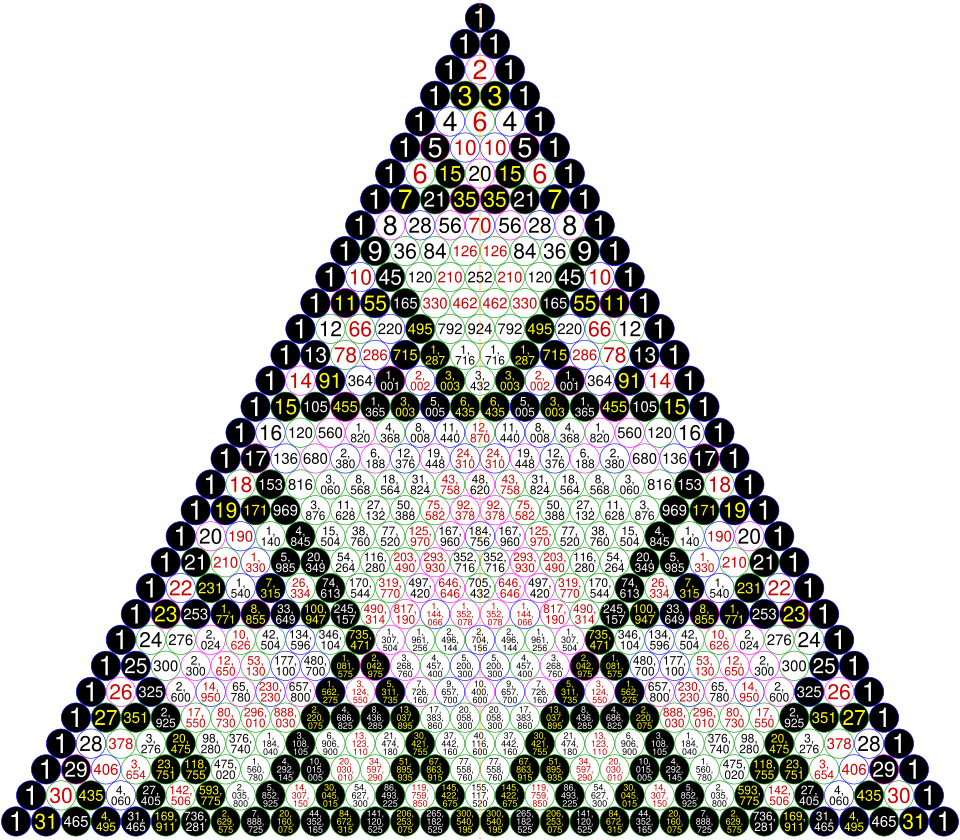
What does this mean? At first glance, Pascal's triangle—1, 1 1, 1 2 1, 1 3 3 1, 1 4 6 4 1...—appears to be nothing more than a collection of numbers. Yet, simply focusing on whether these numbers are odd or even reveals the Sierpinski triangle. In other words, a seemingly unrelated mathematical problem conceals the very same fractal structure. This highlights one of the wonderful aspects of mathematics: rules from seemingly unrelated fields can sometimes give rise to identical structures.
How does it differ from the Sierpinski carpet?
If you have seen both the Sierpinski triangle and the Sierpinski carpet, you might think: 'Don't they look very similar?'Indeed, they share a core concept: starting with a simple, complete shape, repeatedly removing a portion of it, and applying the same rule to the remaining parts—making them classic examples of recursive fractals.
However, they differ in their 'starting shape' and 'hole-cutting rule': one begins with a triangle, while the other starts with a square. This is the most intuitive distinction.
The Sierpinski triangle starts with a single triangle. In each step, the triangle is divided into four identical smaller triangles, and the central one is removed, leaving three triangles; the process is then repeated on these three.
The Sierpinski carpet, on the other hand, starts with a square. It is divided into a 3×3 grid of nine identical smaller squares, and the center square is removed, leaving eight smaller squares; the process is then repeated on these eight.
One involves 'cutting out triangles' while the other involves 'cutting out squares'; the Sierpinski triangle is about cutting triangles out of a triangle, whereas the Sierpinski carpet is about cutting squares out of a square. Although it sounds simple, this subtle difference leads to completely different final patterns after repeated recursion.
Their recursive patterns differ as well. This becomes clearer when we map out the progression from the first to the second iteration.
Sierpinski triangle: 1 triangle → 3 triangles → 9 triangles → 27 triangles → 81 triangles. Each round involves multiplying by 3 (×3). A triangle (△) becomes three smaller triangles (△ △ △), so the final result consistently maintains a distinct triangular structure.
The Sierpinski carpet: 1 square → 8 squares → 64 squares → 512 squares → 4,096 squares. Each round involves multiplying by 8.
So, although both involve constant 'hole-punching,' the triangle retains 3 sub-regions in each step, whereas the carpet retains 8. A square (□) becomes eight smaller squares; the final result looks like a mathematical carpet punched with countless holes.
However, don't view them as completely unrelated fractals; they are actually very similar. They both follow the pattern: simple shape → subdivision → removing a portion → repeating the process on the remainder → increasing complexity. Thus, the Sierpinski Carpet and the Sierpinski Triangle can be seen as two different implementations of the same 'recursive hole-punching' concept—one applied to a triangle and the other to a square.
Why do they look so alike? Because they share a common visual characteristic: infinite holes. The Sierpinski Triangle features triangular holes within a large triangle, with even smaller holes inside those smaller triangles. The Sierpinski Carpet features square holes within a large square, with even smaller holes inside those smaller squares. Consequently, as the number of iterations increases, both structures reveal nested 'worlds of holes.'
There is also an interesting distinction: they have different 'dimensions.'
If you want to delve a bit deeper into the math, you can look at their fractal dimensions. The Sierpinski Triangle transforms from one shape into three in each step, while the side length shrinks to 1/2; thus, its fractal dimension is log(3) / log(2) ≈ 1.585. The Sierpinski Carpet transforms from one shape into eight in each step, while the side length shrinks to 1/3; thus, its fractal dimension is log(8) / log(3) ≈ 1.893. Thus, neither is a standard "solid 2D shape," yet both are more complex than an ordinary line.
Why are these two fractals worth exploring together? When you compare the Sierpinski triangle with the Sierpinski carpet, you discover something fascinating: simply by changing the initial shape and the recursive rules, the resulting world becomes completely different. A triangle—△ → △ → △ → ...—ultimately forms the Sierpinski triangle. A square—□ → □ → □ → ...—ultimately forms the Sierpinski carpet. This illustrates a crucial concept in the study of fractals: what determines the final form is not merely the process of "recursion," but the specific fundamental rules you choose.
How does it differ from the Koch snowflake?
If you have recently explored the Koch snowflake, you will notice they are quite similar. Both begin with simple shapes and use simple rules applied recursively to generate complex structures. However, the direction of their evolution is completely different.
The essence of the Sierpinski triangle is continuous removal. Starting with a solid triangle, the central section is repeatedly removed; the process goes from solid → a hole → more holes → infinite subdivision.
In contrast, the core of the Koch snowflake is continuous addition. Starting with the side of a triangle, new polygonal lines are repeatedly added to the edges; the process goes from simple edge → more complex edge → infinite detail.
One involves carving out while the other involves growing, yet both ultimately result in complex fractal structures.
How does it differ from the Lévy C curve?
The Lévy C curve involves repeatedly replacing line segments. One line → two lines → four lines → eight lines → ...
The Sierpinski triangle involves repeatedly removing triangles. One triangle → three → nine → twenty-seven → ...
So, although both utilize recursion, the methods of generation are completely different.
An Infinite World Within a Triangle
Let's go back to the very beginning.
We start with just one triangle. Then we remove one. Then three. Then nine. Then twenty-seven...
Each step is incredibly simple. Yet, in the end, an ordinary triangle transforms into a geometric world of infinite layers.
You can zoom in and see a triangle. Zoom in again—another triangle. Zoom in once more—still a triangle. Yet, each time, it exists at a smaller scale.
The story of the Sierpinski triangle is actually quite simple: start with a triangle, divide it into four, remove the central one, and repeat the process on the remaining triangles. Repeat, repeat, and repeat again. Ultimately, a simple triangle evolves into an infinitely complex fractal.
It involves no complex formulas, no random processes, and not even many rules—just one simple rule.
But when that rule is repeated enough times, complexity emerges.
Continue Exploring the World of Fractals
The Sierpinski triangle is a classic structure in the world of fractals.
If you enjoy the pattern of simple rules → continuous repetition → complex designs, you might also want to explore the Koch snowflake to see how a simple edge accumulates outward detail to form an infinitely complex snowflake; the Lévy C curve to observe how a straight line gradually 'folds' into a complex curve through a simple generator and recursion; the Dragon curve to see how a simple line folds repeatedly into a mysterious dragon-like shape; or Penrose tiling to discover how two simple tile shapes can cover a surface according to strict matching rules, creating an ordered pattern that never repeats periodically.
While their rules differ, they all demonstrate a fascinating phenomenon in mathematics: simplicity does not mean boredom; a single simple rule, when repeated continuously, is enough to create a world of infinite complexity.
You can also explore more amazing mathematical shapes or read more about the Sierpinski triangle on Wikipedia.
Want to see these stunning mathematical visuals every time you open a new tab? Install the Chrome extension now and set "Math Wonder Box" as your new tab page.🚀
Learn More