Exploring Penrose Tiling
Penrose Tiling: Two shapes, a world that never repeats
If you were given a pile of squares, you could easily arrange them like this:
□□□□□□ □□□□□□ □□□□□□ □□□□□□
□□□□□□ □□□□□□ □□□□□□ □□□□□□
□□□□□□ □□□□□□ □□□□□□ □□□□□□
□□□□□□ □□□□□□ □□□□□□ □□□□□□
Extending left, right, up, and down—no matter how large the tiling becomes, you will find that the pattern constantly repeats.
So, the question arises: Is it possible to tile an entire plane using only a few shapes without the pattern ever truly repeating? The answer is yes—and it requires only two types of tiles.
This is the famous Penrose tiling.
What is “tiling”?
Let’s not overcomplicate things; “tiling” is actually a very simple concept: taking specific shapes and covering an entire flat surface with them, leaving no gaps and ensuring they do not overlap.
Squares, for instance, make this very easy; by repeating them, you can tile infinitely. This type of pattern is called periodic tiling, where the entire pattern can be generated simply by copying and shifting a single small section.
In the 1960s and 1970s, mathematicians began investigating a fascinating question: Is it possible to tile an entire plane using only a finite number of tile shapes while ensuring the pattern never repeats periodically?
Early solutions required a vast number of different tile shapes. Later, in the 1970s, the British mathematician and physicist Roger Penrose proposed an elegant solution. One of the most famous of these requires only two types of tiles—what came to be known as Penrose tiling.
Two Unusual Tiles
Let's start with the most classic pair: the kite tile and the dart tile. Both are quadrilaterals, but they have different shapes.
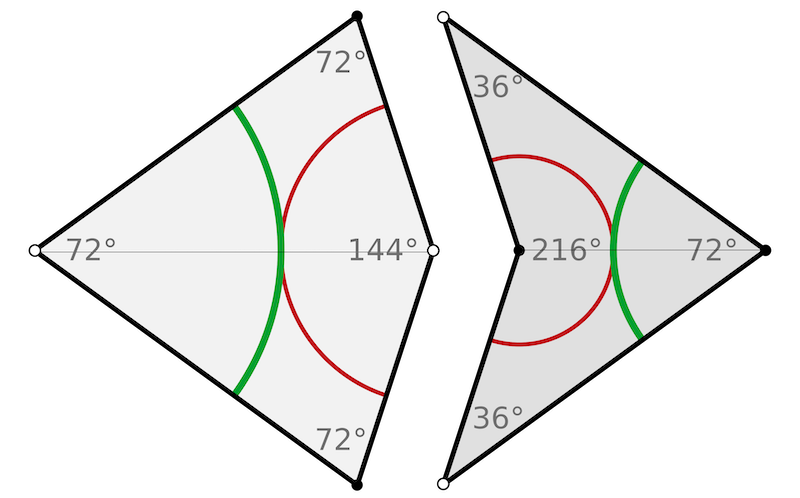
The kite tile is a convex quadrilateral with interior angles of 72°, 72°, 72°, and 144°; it looks just like a kite.
The dart tile is even more unusual; it is a concave quadrilateral with interior angles of 36°, 72°, 36°, and 216°. That 216° angle creates a distinct inward-pointing tip.
However, having just these two types of tiles isn't enough—and this is the most crucial aspect of Penrose tiling. If you were to simply piece the kite and dart tiles together haphazardly, you could actually create a periodic pattern. Therefore, the true magic lies not merely in the 'two shapes' themselves, but in the fact that they must adhere to specific connection rules. These are known as matching rules.
What are matching rules? You can imagine them as small arrows or color markings on the edges of each tile, dictating that adjacent tiles must connect in a specific way. If the connection doesn't match, the tiles cannot be placed together like that. It might seem like a minor constraint, but it is precisely this rule that prevents the pattern from repeating periodically.
Strictly speaking, the kite and dart tiles—which are ordinary quadrilaterals—could themselves produce a periodic tiling. However, what makes this a Penrose aperiodic tiling is the combination of shape and matching rules. These rules can even be built directly into the edges of the tiles—for instance, as tabs and slots—so that the tiles are 'forced' to connect in the prescribed manner.
Now, let's start tiling
Now, let's start tiling. Place a kite-shaped tile, then a dart-shaped tile, then a kite-shaped tile, then a dart-shaped tile...
You will notice that they begin to form beautiful patterns—sometimes resembling five-pointed stars, sometimes suns, sometimes flowers, and at other times, the decorative motifs of an ancient civilization. Moreover, the patterns appear highly ordered.
But it never truly repeats; this is the most magical aspect of Penrose tiling.
You might look at it and think, 'Haven't I seen this pattern before?' Indeed, you will see similar structures—similar stars, similar flowers, similar local motifs. However, you will never find a fixed, small pattern that can simply be copied and shifted to tile the entire plane. In other words: it possesses order, yet lacks periodicity.
It looks like repetition, but there is no actual repetition; this is what makes Penrose tiling so fascinating. With ordinary tiles, the sequence is: pattern → repetition → repetition → repetition. With Penrose tiling, it is: pattern → variation → variation → variation. Yet, it is not random—quite the opposite; the placement of every single tile is governed by strict rules. The result is a world that is ordered, yet non-repeating.
It is not a random pattern.
Upon first seeing a Penrose tiling, some might think: 'Isn't this just randomly piecing together two types of tiles?'
Not at all. If the tiles were placed randomly, you would quickly encounter gaps and overlaps, violate matching rules, and disrupt the overall structure.
Penrose tiling is highly rule-governed. You cannot place tiles haphazardly; there are numerous constraints at every step. Yet, despite this, the result is not a simple repeating pattern.
Penrose tiling is not random; it possesses a profound geometric structure. A crucial figure here is the Golden Ratio—φ ≈ 1.618—as many geometric relationships within the tiling are linked to it. For instance, the Golden Ratio appears in the relationship between the side lengths of the 'kite' and 'dart' tiles. Thus, you will find that while the pattern never repeats, it is not devoid of order; it is underpinned by strict mathematical proportions.
If you examine a Penrose tiling closely, you will often spot five-pointed stars. This is because its geometry is intimately tied to pentagons and five-fold rotational symmetry—and pentagons, in turn, have a deep connection to the Golden Ratio. Consequently, the Golden Ratio, pentagons, five-pointed stars, and Penrose tilings frequently appear together. Penrose tiling can even exhibit five-fold rotational symmetry while lacking translational periodicity.
Symmetry without repetition—this is perhaps one of the most beautiful features of Penrose tiling. We often readily associate symmetry with repetition, but Penrose tiling shows us that the two are not the same thing at all. A pattern can be highly symmetrical yet never repeat periodically; it represents a geometric world that defies intuition.
Imagine standing in an infinite Penrose world, walking on and on. You will constantly encounter new patterns. You might come across a five-pointed star, walk further to find another, and then see similar structures again. Yet, you will never reach a point where you can say, 'Right, from this spot onwards, the pattern is exactly the same as before.' Because there is no fixed period, this world is infinite and ordered, yet it never repeats mechanically.
Local rules, creating infinite structures.
In fact, there is more than one version. If you search online for Penrose tiling, you might come across the thin rhombus and thick rhombus combination; this is another classic form of Penrose tiling, usually known as P3. Meanwhile, the kite and dart tiles belong to the P2 category. There is also the earlier P1 form. Strictly speaking, therefore, Penrose tiling is not a single, fixed pattern, but rather a family of aperiodic tilings that satisfy specific rules.
Here is a fascinating question: how can two types of tiles cover an infinite plane? One might naturally wonder, "Since the pattern cannot repeat, how can we guarantee that no gaps are left behind?" This is precisely the brilliance of Penrose tiling. The matching rules do not simply tell you, "You cannot place this tile there." Instead, as the tiling progresses, they progressively constrain the choices for subsequent tiles. Once a tile is placed, the surrounding positions become constrained; the next tile is then subject to those constraints, and the one after that follows suit. Ultimately, the entire infinite structure is organized by a set of local rules.
This is precisely the most thought-provoking aspect of Penrose tiling. We need only observe how adjacent tiles connect; there is no need for a massive map dictating what the "entire universe" should look like. By simply adhering to local rules, the cumulative effect of these rules gives rise to an infinitely large, aperiodic, and highly ordered whole. This bears a resemblance to fractals: a complex whole can emerge from simple local rules.
However, Penrose tiling is not a fractal; it is not the same type of mathematical object as the Mandelbrot set or the Koch snowflake.
The Koch snowflake continuously adds detail through recursion; at its core lies the concept of recursion, addressing the question: "What does a simple shape become when it undergoes continuous recursion?"
Penrose tiling organizes an infinite plane through specific tiling rules; at its core lie aperiodic tiling and matching rules. Thus, it essentially asks: "Can a finite set of shapes form an infinite world that never repeats?"
How does it differ from ordinary mosaics?
Ordinary mosaics typically rely on repetition. For example: ◇◇◇◇ ◇◇◇◇ ◇◇◇◇. You identify a small unit—◇—and simply replicate it over and over.
Penrose tiling works the exact opposite way; you cannot find a single, finite unit that can simply be copied → shifted → copied → shifted to cover the entire plane. Thus, it resembles a decorative pattern, yet lacks the simple repeating units found in standard decorative designs.
Even more remarkable: it once prompted physicists to rethink crystals
Penrose tiling is more than just an elegant mathematical game.
In 1984, Israeli physicist Dan Shechtman discovered materials with a quasicrystal structure—a discovery that earned him the 2011 Nobel Prize in Chemistry. These materials possess an ordered structure but lack the standard periodicity found in conventional crystals. Penrose's quasi-periodic tiling later became a key mathematical model for understanding such structures.
Thus, a problem that initially appeared to be merely a mathematical pattern turned out to have a connection to the real material world.
A World That Never Repeats
Looking back at Penrose tiling, it consists of only two basic tile shapes governed by simple rules. Yet, as we extend the pattern infinitely, it does not devolve into a simple ABABABAB... sequence, nor does it become a single small motif endlessly copied. Instead, it maintains constant order without ever truly repeating—and that is precisely what makes Penrose tiling so fascinating.
You can go looking for 'repetition' yourself: zoom in, zoom out, or shift your view and ask, 'Have I seen this part before?' You might discover similar sections or even identical finite patterns, but you will never find a periodic unit that can be endlessly translated—because it is, quite simply, a world that never repeats.
Perhaps this is because it embodies two seemingly contradictory qualities: order and freedom. It is not random—every tile follows a rule—yet it is not mechanically repetitive, lacking any simple periodicity. It follows a pattern yet never repeats; it possesses symmetry yet lacks translational periodicity; and though it uses only two types of tiles, it creates a world of infinite complexity.
Starting with Two Tiles
To begin with, we had only kite-shaped and dart-shaped tiles—two seemingly unremarkable geometric shapes. Then, we applied specific matching rules. Next came the first tile, the second, the third... expanding further and further. Ultimately, these two types of tiles can tile an entire infinite plane.
Yet, if you try to find a fixed repeating pattern, you never will. That is because this world was designed from the very start to move forever forward without ever repeating. This is Penrose tiling.
Continue Exploring the World of Geometry
Penrose tiling represents a truly unique mathematical realm.
If you enjoy the experience of simple rules giving rise to complex structures, you might also want to explore the Koch snowflake—witnessing how a simple edge transforms through recursion into an infinitely complex mathematical snowflake. Or the Lévy C curve, where a straight line folds repeatedly via a simple generator to create a complex fractal structure. Or the Dragon curve, seeing how a line folds continuously to form an intricate fractal pattern. And finally, the Apollonian gasket, where the gaps between circles give birth to ever-smaller circles.
While they explore different concepts, they all convey the same message: Mathematical order does not necessarily imply repetition; sometimes, the most breathtaking worlds are those that follow consistent rules yet never exactly repeat themselves.
You can also view more fascinating mathematical shapes or read more about Penrose tiling on Wikipedia.
Want to see these stunning mathematical visuals every time you open a new tab? Install the Chrome extension now and set "Math Wonder Box" as your new tab page.🚀
Learn More